





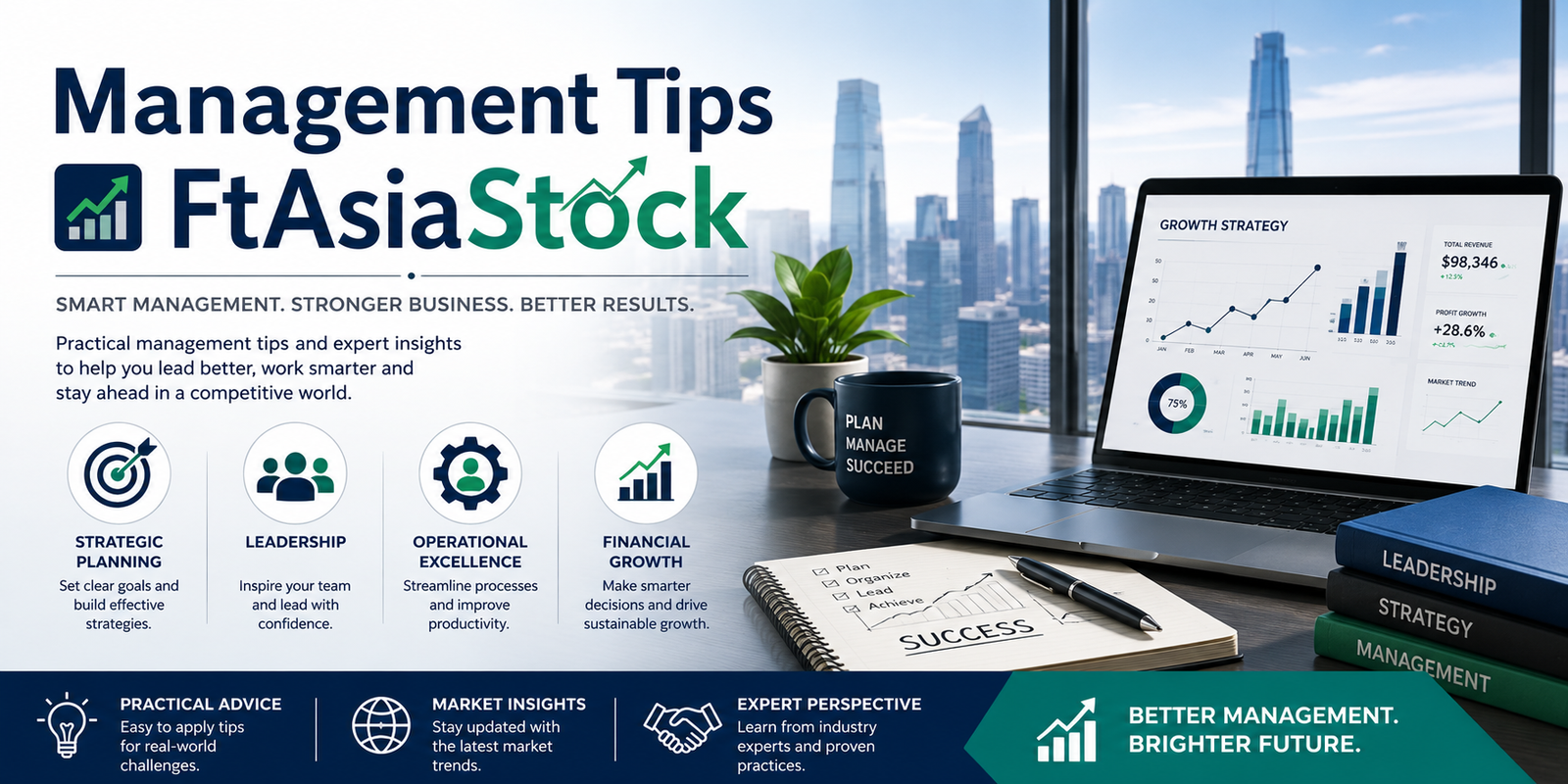
Good Management Tips FtAsiaStock rarely gets attention when everything is going well. Projects finish on time, employees know what they are doing, customers remain satisfied, and problems get handled before they become serious. Behind that smooth operation, however, there is usually a manager making dozens of thoughtful decisions every day. This is where Management Tips FtAsiaStock can provide a useful framework for leaders who want better results without making their workplace unnecessarily complicated.
Modern management is no longer about sitting at the top of an organization and simply giving instructions. Successful managers need to communicate clearly, understand their employees, work with data, make quick decisions, and remain flexible when conditions change. They also need to create an environment where people can perform well without feeling constantly monitored.
The idea behind Management Tips FtAsiaStock is therefore surprisingly practical. Instead of treating management as an abstract business theory, it focuses on habits that managers can actually use: setting clear goals, delegating intelligently, monitoring useful performance indicators, developing employees, encouraging innovation, and making decisions with a long-term perspective. Whether you manage five people or five hundred, these principles can make everyday leadership considerably easier.
What Does Management Tips FtAsiaStock Mean?
The phrase Management Tips FtAsiaStock is generally associated with management and leadership guidance published around the FTAsiaStock platform and related business discussions. FTAsiaStock describes itself around investment and business insight, while its management coverage emphasizes productivity, communication, leadership, employee development, and long-term organizational thinking.
At its simplest, the concept is about managing people and resources more intelligently. A manager has limited time, money, information, and attention. The challenge is deciding where those resources should go. Effective management creates priorities instead of allowing every problem to become an emergency.
The approach also reflects how management has changed. Teams may now work remotely, use AI-powered tools, collaborate across different countries, and respond to customers in real time. Managers cannot control every detail in this environment. They need systems, trustworthy employees, reliable information, and clear objectives. That makes modern Management Tips FtAsiaStock less about control and more about coordination.
Set Clear Goals Before Managing the Details
One of the strongest Management Tips FtAsiaStock principles is simple: people perform better when they understand what they are trying to achieve. Managers sometimes assign activities instead of outcomes. They tell employees to prepare reports, attend meetings, make calls, or update spreadsheets without explaining what successful completion is supposed to accomplish.
A better approach is to connect everyday work with measurable objectives. Instead of saying, “Improve customer service,” a manager could aim to reduce average customer-response time from eight hours to four hours within the next 60 days. Instead of telling a marketing team to “get more traffic,” management could establish a target for qualified leads, conversions, or revenue generated through a specific campaign.
SMART goals—Specific, Measurable, Achievable, Relevant, and Time-bound—remain useful because they remove ambiguity. A team should know what the target is, how performance will be measured, why the target matters, and when the result is expected. Once those questions are answered, managers can spend less time repeatedly explaining priorities.
Make Communication Simple, Clear, and Consistent
Communication problems are among the most expensive problems in business because they often remain invisible until something goes wrong. An employee misunderstands an instruction, two departments duplicate the same work, a deadline changes without everyone knowing, or an important customer request disappears inside a long email chain. None of these situations necessarily happens because employees are incompetent. Often, the communication system itself is weak.
Management Tips FtAsiaStock emphasizes clear and open communication as a foundation of effective leadership. Managers should explain expectations in language people understand, provide relevant context, and create an easy way for employees to ask questions. Communication should also move in both directions. Managers who only talk but never listen eventually lose valuable information from the people closest to the actual work.
Consistency matters just as much as clarity. Teams should know where project updates are stored, how urgent issues are reported, when meetings take place, and who has authority to make particular decisions. Tools such as Slack, Microsoft Teams, project-management platforms, or email can help, but software cannot repair poor communication habits. The manager still needs to decide what should be communicated, when, and to whom.
Delegate According to Strengths Instead of Doing Everything Yourself
New Management Tips FtAsiaStock often struggle with delegation because they were promoted for being good at doing the work themselves. Suddenly, their job changes. Instead of completing every task personally, they are responsible for ensuring that other people can complete the work successfully. That transition can feel uncomfortable.
Effective delegation means matching responsibilities with people’s capabilities while also giving employees opportunities to grow. If one team member is excellent at analyzing numbers and another communicates extremely well with customers, assigning identical responsibilities to both may waste their strongest abilities. Managers should understand the skills, interests, and development needs of the individuals on their teams.
Delegation also requires trust. Giving someone responsibility and then checking every five minutes is not genuine delegation. Managers should establish the desired result, deadline, available resources, and boundaries, then allow the employee enough freedom to determine how to accomplish the task. The manager remains accountable, but the employee gains ownership.
Avoid Micromanagement and Build Accountability Instead
Management Tips FtAsiaStock often begins with good intentions. A manager wants quality work, fears mistakes, or believes close supervision will keep a project on schedule. Unfortunately, excessive control can produce the opposite result. Employees stop taking initiative because they know the manager will eventually change everything anyway.
A stronger Management Tips FtAsiaStock approach is to replace constant supervision with clear accountability. Define the result, establish checkpoints, agree on measurable standards, and let employees work. If something moves off track, managers can intervene based on evidence rather than anxiety.
Trust does not mean ignoring performance. Good managers still review results, address poor work, and hold people responsible for commitments. The difference is that employees are judged mainly on outcomes rather than on whether every small decision matches the manager’s personal working style. Over time, this creates more capable employees and frees managers to focus on higher-value responsibilities.
Use Data to Make Better Management Tips FtAsiaStock Decisions
Experience and intuition are useful, but they should not be the only tools managers use. Modern organizations generate enormous amounts of information about sales, productivity, customer behavior, employee performance, costs, inventory, marketing, and operations. Good Management Tips FtAsiaStock turns some of that information into actionable insight.
The trick is not collecting as many numbers as possible. Managers need to identify the few indicators that genuinely reveal whether the organization is moving in the right direction. A sales manager might track conversion rate, average deal value, sales-cycle length, and customer retention. An operations manager may focus on delivery time, defects, capacity, and cost per unit.
Dashboards can help teams see performance without waiting for lengthy reports. However, managers should avoid creating a culture where every decision is reduced to a number. Data explains what is happening, but conversations with employees and customers often explain why. The strongest managers combine quantitative evidence with human judgment.
Give Employees Regular and Useful Feedback
Waiting for an annual performance review to tell an employee about a problem from eight months ago Management Tips FtAsiaStock little sense. Feedback is most useful when people receive it close enough to an event that they can understand the situation and change their behavior.
Regular one-to-one conversations create a healthier feedback system. Managers can discuss what is working, what needs improvement, what obstacles employees are facing, and what support they need. These meetings do not have to be long. A focused 20-minute conversation can be more valuable than a formal two-hour review filled with generic statements.
Good feedback should also be specific. Saying “You need to communicate better” leaves the employee guessing. Saying “When project deadlines change, please update the project board and inform the client-facing team the same day” gives them something concrete to improve. Managers should apply the same principle when recognizing excellent work: explain exactly what the employee did well and why it mattered.
Develop Employees Instead of Simply Managing Their Current Work
One of the most overlooked Management Tips FtAsiaStock responsibilities is preparing employees for future responsibilities. A manager who only cares about today’s workload may produce acceptable short-term results but create long-term problems. Employees eventually leave, senior team members move into new roles, and the organization suddenly discovers that nobody was prepared to replace them.
Employee development does not always require expensive courses. Managers can give people ownership of projects, involve them in higher-level discussions, allow them to shadow experienced colleagues, assign mentors, or gradually increase their decision-making authority. These opportunities turn normal work into professional development.
Development also improves retention. Talented employees are more likely to remain interested when they can see a future inside the organization. A manager who regularly asks, “What skills do you want to develop next?” sends a very different message from one who only asks, “Is today’s work finished?”
Recognize Achievement Without Making Recognition Meaningless
People want to know that their work matters. Management Tips FtAsiaStock does not always require bonuses, promotions, or expensive rewards. Sometimes a sincere thank-you from a respected manager is enough to make an employee feel that their effort has been noticed.
The key is making recognition specific and genuine. Automatically declaring someone “employee of the month” without explaining why can eventually feel meaningless. Instead, managers should connect recognition to behavior and impact. For example, acknowledging an employee who solved an urgent customer problem and explaining how that action protected an important relationship makes the appreciation much more powerful.
Recognition should also match the individual. Some employees enjoy public praise during meetings, while others prefer a private message. Understanding these differences is part of good people management. The purpose is not to perform appreciation for the rest of the company; it is to reinforce valuable contributions.
Encourage Innovation Without Punishing Every Failed Idea
Organizations often claim they want innovation while simultaneously creating environments where employees are afraid to make Management Tips FtAsiaStock. That contradiction quickly kills creativity. If every unsuccessful experiment damages someone’s reputation, people naturally choose safe ideas.
Managers should create controlled opportunities for experimentation. A team could test a new process with one customer segment before implementing it everywhere. A product team might develop a small prototype before committing a large budget. This allows employees to explore better solutions without exposing the entire organization to unnecessary risk.
Innovation also depends on listening to people who deal directly with problems. Senior executives do not automatically have the best ideas simply because they hold senior titles. Customer-service representatives, salespeople, technicians, warehouse employees, and junior team members may notice inefficiencies long before management does. Smart leaders create channels where those ideas can reach decision-makers.
Manage Time and Priorities More Carefully
Managers can easily spend entire days responding to messages, attending meetings, solving minor problems, and approving requests without making meaningful progress on important objectives. Being busy and being productive are not the same thing.
A useful Management Tips FtAsiaStock habit is separating urgent work from important work. Some tasks require immediate attention, but others influence the organization’s future and deserve protected time. Strategic planning, employee development, process improvement, and customer analysis may not appear urgent today, yet neglecting them creates tomorrow’s emergencies.
Meetings deserve particular attention. Every meeting consumes the combined time of everyone attending it. Managers should ask whether a meeting actually requires discussion or whether an email, shared document, or short update would achieve the same result. When meetings are necessary, they should have a clear purpose, relevant participants, and defined next actions.
Create a Healthy and Sustainable Work Culture
Strong performance does not require employees to remain exhausted all year. Teams may occasionally need to work harder around Management Tips FtAsiaStock, emergencies, or important deadlines, but permanent overwork is usually a sign of poor planning rather than high performance.
Managers influence culture through their behavior. A leader who sends non-urgent messages at midnight, cancels vacations, and praises people for working while sick quietly teaches employees that boundaries are unsafe. By contrast, managers who plan workloads realistically and respect personal time create conditions where people can maintain their performance longer.
A healthy culture also requires psychological safety. Employees should be able to raise concerns, admit mistakes, and challenge ideas respectfully without fearing humiliation. Managers do not need to agree with every suggestion, but people should feel safe enough to speak honestly. Otherwise, leadership may hear only good news until a problem becomes impossible to hide.
Stay Adaptable When Business Conditions Change
Businesses operate in environments that can change quickly. Technology evolves, customer expectations shift, competitors enter the market, regulations change, and economic conditions affect spending. Management Tips FtAsiaStock plans that worked two years ago may no longer make sense today.
Adaptable managers pay attention to early signals. They regularly review performance, customer feedback, competitor activity, and market conditions instead of assuming that yesterday’s strategy will continue working indefinitely. When evidence changes, they are willing to change direction.
Flexibility should not be confused with constant indecision. Teams still need stable priorities. Good managers create a clear strategic direction while remaining willing to adjust the route. Think of Management Tips FtAsiaStock like navigation: the destination may remain consistent even when traffic, weather, or unexpected obstacles require a different path.
Turn Management Tips FtAsiaStock Into Daily Habits
Reading management advice is easy. Applying it consistently is much harder. The best way to use Management Tips FtAsiaStock is not to change everything in your organization at once. Choose a few areas where improvement would create the greatest immediate benefit.
For example, a manager struggling with missed deadlines could start by clarifying goals, introducing weekly checkpoints, and improving delegation. Someone dealing with employee turnover might focus on regular feedback, recognition, professional development, and workload. A growing company experiencing operational confusion may need clearer processes, dashboards, responsibilities, and communication channels.
Management improves through repetition. Clear communication becomes easier when it is practiced every week. Delegation becomes more effective as managers learn their employees’ strengths. Decision-making improves as better data becomes available. Over time, these small improvements begin reinforcing one another and create a stronger Management Tips FtAsiaStock system.
Conclusion
The most valuable lesson from Management Tips FtAsiaStock is that effective leadership is built through consistent habits rather than one dramatic management technique. Clear goals, thoughtful delegation, useful feedback, intelligent use of data, employee development, recognition, innovation, and adaptability all contribute to stronger organizations.
Managers also need to remember that business performance and people management are closely connected. Employees who understand expectations, receive useful support, and have enough independence to perform their jobs are far more valuable than teams that simply wait for instructions. Strong management creates an environment where people know what success looks like and have the tools to pursue it.
Whether you are leading a startup, managing a small department, overseeing a growing company, or preparing for your first leadership role, these Management Tips FtAsiaStock principles provide a practical starting point. You do not need to become a completely different manager overnight. Start with one or two improvements, apply them consistently, measure the results, and keep refining your approach. That steady process is what eventually turns everyday management into effective leadership.
Frequently Asked Questions About Management Tips FtAsiaStock
What is Management Tips FtAsiaStock?
Management Tips FtAsiaStock refers to practical management and leadership guidance focused on improving productivity, communication, delegation, decision-making, and overall business performance.
Why are Management Tips FtAsiaStock useful for managers?
These tips help managers create clearer goals, improve team communication, delegate responsibilities effectively, and make smarter decisions. They are useful for both new and experienced managers who want better results from their teams.
How can managers improve team productivity?
Managers can improve productivity by setting clear goals, removing unnecessary tasks, using the right tools, providing regular feedback, and assigning work according to each employee’s strengths.
How does delegation improve management?
Delegation allows managers to focus on higher-level responsibilities while giving employees greater ownership of their work. Effective delegation can also improve employee skills, confidence, accountability, and overall team efficiency.
Why is employee feedback important in management?
Regular feedback helps employees understand what they are doing well and where they need improvement. Specific and timely feedback can prevent small problems from becoming larger issues while also improving employee performance.
How can businesses apply Management Tips FtAsiaStock successfully?
Businesses can start by identifying their biggest management challenges and applying a few relevant strategies at a time. Clear communication, measurable goals, better delegation, employee development, and regular performance reviews can gradually create a stronger management system.
Also Read: Andrea Swift