






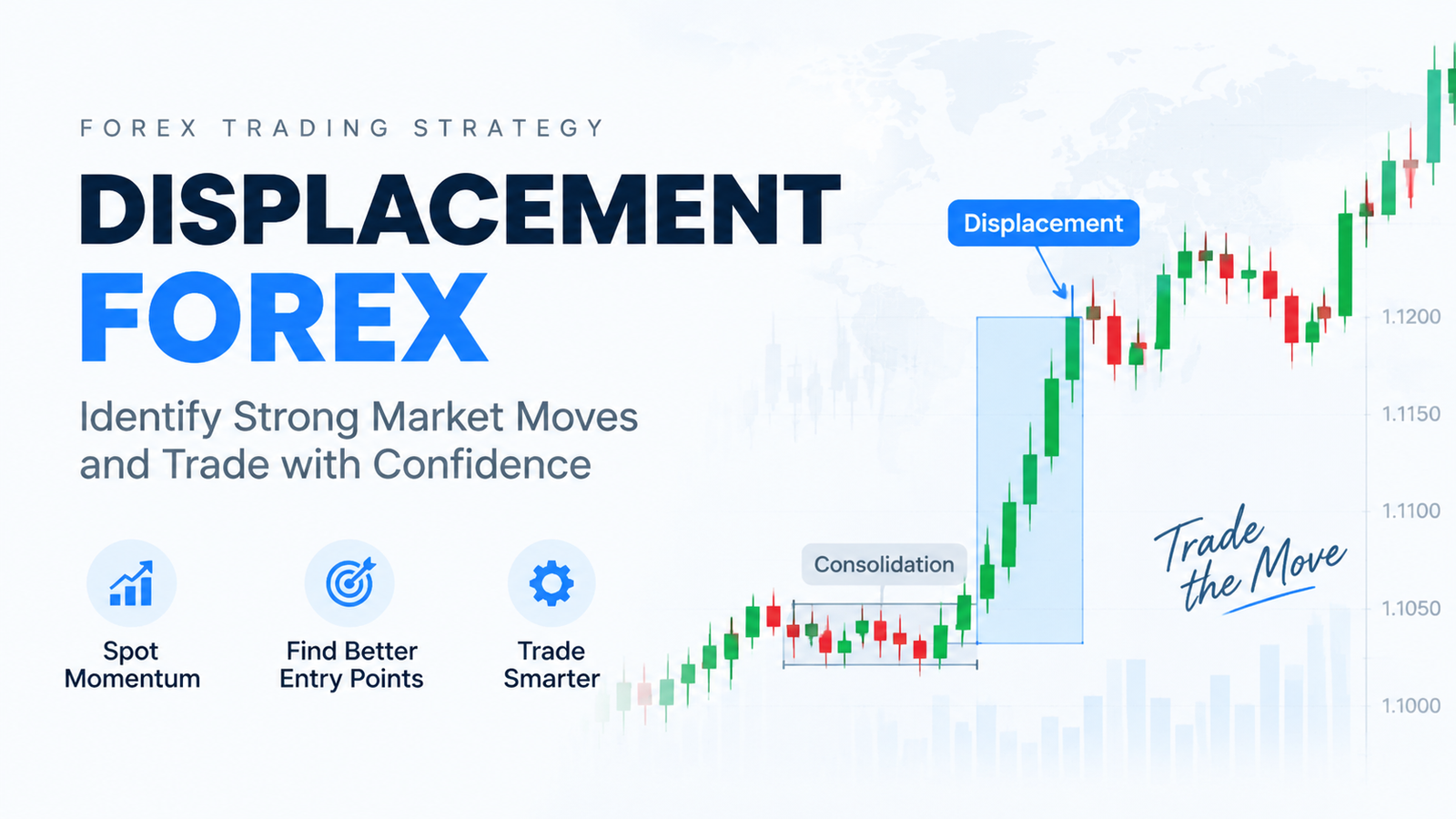
Displacement Forex trading is all about understanding price movement. Every candle on a chart tells a story about buyers, sellers, liquidity, and market psychology. While many traders focus on indicators, moving averages, and traditional patterns, experienced traders often pay closer attention to how price moves with strength and intention. One important concept that helps traders understand these powerful movements is Displacement Forex.
In simple words, displacement in forex refers to a strong and aggressive price movement where the market quickly travels in one direction with strong momentum. These moves usually appear as large-bodied candles with limited wicks, showing that one side of the market has taken control. Traders who follow Smart Money Concepts (SMC) and ICT-style analysis often study displacement to identify institutional activity and potential trading opportunities.
Understanding displacement is not about predicting every market move or finding a magical entry signal. Instead, it helps traders read market behavior more clearly. When displacement occurs, it often reveals important information about market sentiment, liquidity movement, and possible changes in market structure.
This guide explains what forex displacement is, how to identify it, how traders use it, the relationship between displacement and fair value gaps, and common mistakes beginners should avoid.
What Is Displacement Forex?
Displacement Forex is a term used to describe a rapid and powerful price movement caused by strong buying or selling pressure. Instead of a slow and balanced price movement, displacement represents a market condition where price moves aggressively from one area to another.
For example, imagine EUR/USD trading in a narrow range for several hours. Suddenly, large bullish candles appear and push the price significantly higher within a short period. This aggressive movement is considered bullish displacement because buyers have created enough pressure to move the market quickly.
The opposite can also happen. If sellers suddenly enter the market and push price lower with strong bearish candles, it is called bearish displacement. The direction of the movement depends on whether buyers or sellers are controlling the market.
Many professional traders associate Displacement Forex with institutional order flow. Large financial institutions cannot always enter positions instantly without affecting price. Their large orders often create noticeable movements on the chart, which retail traders may observe as displacement. However, traders should remember that a strong candle alone does not always guarantee institutional involvement. Proper context and confirmation are still necessary.
How Does Forex Displacement Forex Work?
To understand Displacement Forex, traders need to understand how markets move. Price does not move randomly. It constantly searches for liquidity, reacts to buying and selling pressure, and creates new price levels.
A normal market movement usually shows a balance between buyers and sellers. Candles may have smaller bodies, mixed directions, and frequent retracements. During displacement, this balance disappears temporarily because one side becomes much stronger.
When buyers dominate, price moves upward quickly because sellers cannot absorb the buying pressure. This creates a bullish displacement. When sellers dominate, price falls aggressively, creating bearish displacement.
One important feature of displacement is speed. A genuine displacement move usually covers a significant amount of price range in a short period. It shows urgency in the market. Traders often use this information to understand whether a breakout or market structure change has real strength behind it.
For example, if price slowly breaks above a previous high with small candles, the breakout may not have strong confirmation. However, if price breaks the same level with large bullish candles and strong momentum, traders may consider it a Displacement Forex move because the market is showing commitment.
Key Characteristics of a Displacement Forex Move
Identifying Displacement Forex requires more than simply looking for a large candle. Many beginners make the mistake of considering every big candle as displacement. A proper displacement move usually has several important characteristics.
The first characteristic is strong candle momentum. Displacement candles typically have large bodies compared to previous candles. The candles often close strongly in the direction of movement, showing that buyers or sellers maintained control throughout the candle formation.
The second characteristic is limited wick formation. A bullish displacement candle often has a small upper and lower wick because buyers pushed price upward with little resistance. Similarly, bearish displacement candles usually have small wicks because sellers dominated the movement.
The third characteristic is speed and distance. A true displacement move should create a noticeable shift in price. If a candle is large but price quickly returns to the previous range, it may simply be volatility rather than meaningful displacement.
Another common feature is the creation of a Fair Value Gap (FVG). Many ICT traders consider the imbalance created between candles as an important confirmation of displacement because it shows that price moved too quickly and left an inefficient area behind.
Bullish Displacement in Forex
Bullish Displacement Forex happens when buyers aggressively push the market upward. It usually indicates strong demand and increased buying pressure.
A typical bullish displacement appears after a period of consolidation, liquidity collection, or a market reversal area. Price may remain trapped in a small range before suddenly breaking upward with strong bullish candles.
For example, GBP/USD may spend several hours moving sideways. Suddenly, three consecutive bullish candles appear, breaking a previous resistance level and creating an imbalance. This movement suggests that buyers have taken control.
Traders often study bullish displacement because it can provide clues about future price direction. If price retraces back into the displacement area, some traders look for buying opportunities based on additional confirmations such as support zones, market structure, or liquidity behavior.
However, bullish Displacement Forex does not guarantee that price will continue rising. Markets can create false moves, especially around major economic news events. Risk management remains essential.
Bearish Displacement in Forex
Bearish displacement is the opposite of bullish Displacement Forex. It occurs when sellers aggressively take control and force price lower.
During bearish displacement, traders usually observe strong bearish candles with large bodies and limited retracement. The movement often breaks important support levels or creates a shift in market structure.
For example, if USD/JPY has been moving upward but suddenly experiences a series of powerful bearish candles breaking below a previous low, this could represent bearish displacement. Sellers are showing strength and changing the short-term market direction.
Many traders use bearish Displacement Forexas confirmation that selling pressure is genuine. Instead of entering immediately after the move, some traders wait for price to return to an imbalance area or previous zone before considering a trade.
Like bullish displacement, bearish displacement should always be analyzed with broader market context. A single aggressive move does not automatically mean a long-term trend reversal.
Relationship Between Displacement Forexand Fair Value Gap
Fair Value Gap (FVG) is one of the most discussed concepts connected with Displacement Forex trading. A Fair Value Gap occurs when price moves so quickly that there is an imbalance between buyers and sellers.
During a strong displacement move, price may skip certain areas because of aggressive buying or selling. This creates an inefficient price zone that traders often mark on their charts.
For example, during bullish displacement, three candles may form where the middle candle creates a noticeable gap between the previous and following candle ranges. Traders often watch these areas because price may return to them before continuing the original movement.
The reason traders pay attention to FVGs is that markets often seek balance after aggressive movements. A retracement into the gap may provide an opportunity to enter with better risk-to-reward conditions.
However, FVGs should not be traded alone. Many traders combine them with market structure, liquidity zones, and overall trend direction for stronger confirmation.
How Traders Use Displacement Forex in Their Strategies
Many traders use Displacement Forex as a confirmation tool rather than a standalone strategy. It helps them understand when a market move has real momentum behind it.
One common approach is using displacement to confirm a Market Structure Shift (MSS). When price breaks an important high or low with strong displacement, traders may interpret it as evidence that market control has changed.
Another method is waiting for a retracement after displacement. Instead of chasing a large candle, traders wait for price to return to a previous imbalance, order block, or support/resistance area. This approach allows them to enter with a smaller stop loss.
Displacement can also help traders avoid weak setups. If a breakout occurs without strong momentum, traders may consider it less reliable. Strong displacement provides additional evidence that the market has enough pressure to continue moving.
Professional traders usually combine displacement with multiple factors rather than relying on it alone. Market conditions, timeframe analysis, economic events, and risk management all play important roles.
Common Mistakes Traders Make With Displacement Forex
One of the biggest mistakes beginners make is entering trades immediately after seeing a large candle. A large candle does not always mean a strong opportunity. Sometimes it represents the final stage of a move before a reversal.
Another mistake is ignoring market location. Displacement in the middle of a random range may not have the same meaning as displacement from a major support, resistance, or liquidity area.
Many traders also confuse volatility with displacement. News releases can create extremely large candles, but these moves may not represent sustainable market direction. Traders should analyze the reason behind the movement.
A final mistake is using displacement without proper risk management. Even the strongest setups can fail. Successful trading requires controlling losses and maintaining discipline.
Final Thoughts on Displacement Forex
Displacement Forex is a powerful concept that helps traders understand aggressive market movements and possible institutional activity. By studying strong price movements, candle behavior, liquidity, and imbalances, traders can develop a deeper understanding of how markets operate.
However, displacement is not a guaranteed prediction tool. It works best when combined with other forms of analysis, including market structure, liquidity concepts, and proper risk management.
The biggest advantage of learning displacement is that it changes the way traders view charts. Instead of simply watching candles move, they begin understanding the story behind those movements. With practice and patience, displacement can become a valuable part of a trader’s overall strategy.
Frequently Asked Questions
What does displacement mean in forex trading?
Displacement refers to a strong and rapid price movement caused by aggressive buying or selling pressure. It usually appears through large candles moving strongly in one direction.
Is displacement the same as a breakout?
No. A breakout is simply price moving beyond a previous level, while displacement describes the strength and speed behind that movement.
Can beginners use displacement trading?
Yes, beginners can learn displacement concepts, but they should first understand basic price action, risk management, and market structure.
Does every large candle represent displacement?
No. A large candle alone is not enough. Traders usually look for momentum, follow-through, structure breaks, and imbalance confirmation.
Which timeframe is best for finding displacement?
Displacement can appear on any timeframe, but many traders analyze higher timeframes for direction and lower timeframes for entries
Also Read: Abithelp Tablets