






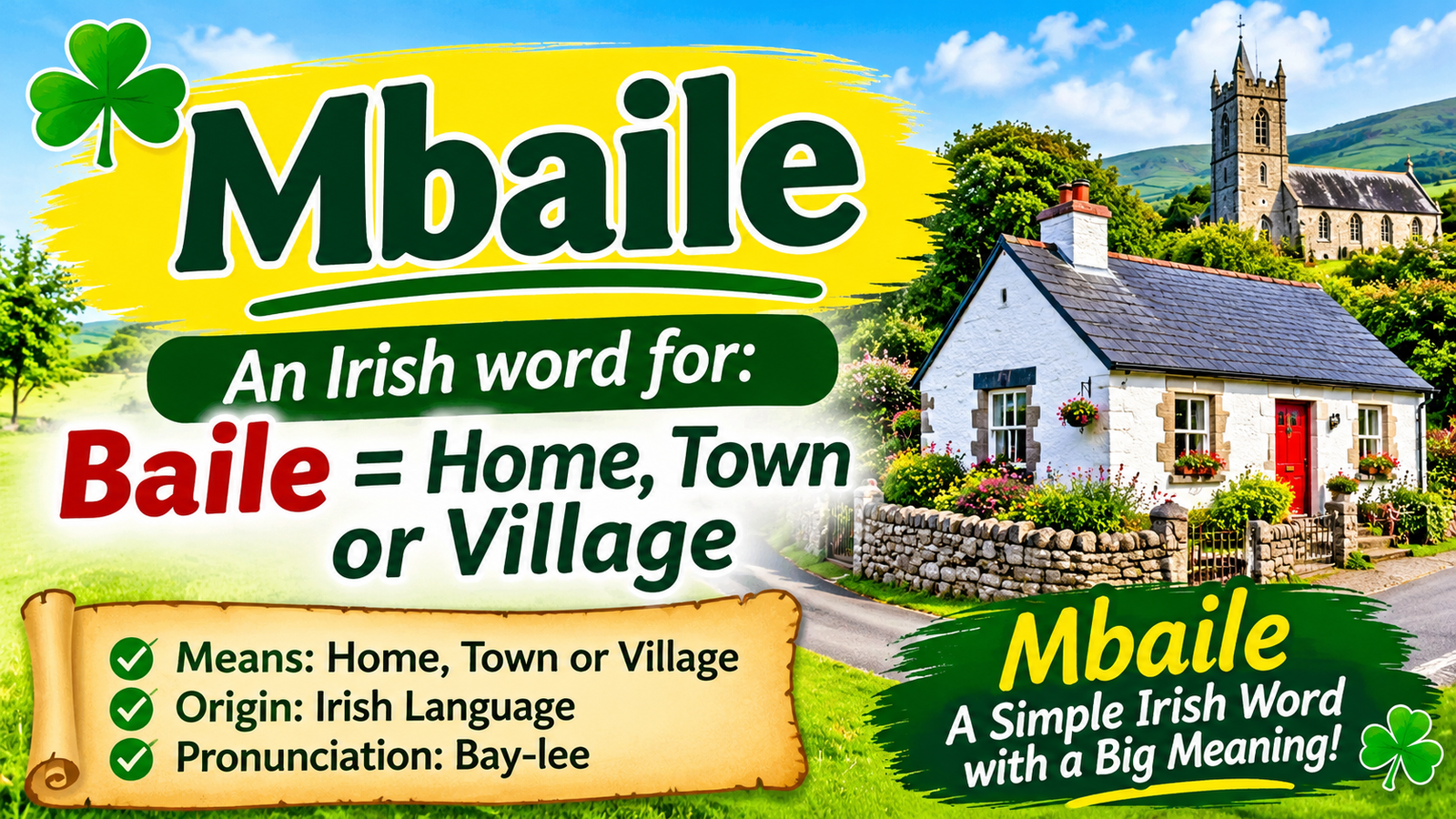
Language is full of interesting words that carry more meaning than their spelling might initially suggest. One example is Mbaile, an Irish-language form that may look unfamiliar to people who have not studied Irish grammar. Although it might appear to be a completely independent word, Mbaile is actually a grammatical form of the Irish word baile, which is associated with meanings such as home, town, village, and locality.
Understanding Mbaile requires looking beyond its individual letters. Irish is a language with a distinctive grammatical structure, and one of its important features is the ability to change the beginning of certain words depending on the surrounding grammatical construction. This process is known as initial mutation. In particular, Mbaile is associated with a process called eclipsis, which explains why the original letter at the beginning of baile appears differently.
For language learners, translators, researchers, and anyone interested in Irish culture, Mbaile offers a useful opportunity to understand how grammar influences vocabulary. Learning its meaning also makes it easier to recognize familiar Irish expressions and place names. Rather than memorizing it as an unrelated word, it is more helpful to understand its connection with baile and the grammatical rules that determine when its spelling changes.
What Does Mbaile Mean?
Mbaile is the eclipsed form of the Irish noun baile. It does not normally represent a completely different word with an unrelated definition. Instead, it is a modified form that appears when Irish grammatical rules require eclipsis. The underlying meaning remains connected to the original noun, although its English translation depends on the complete phrase in which it appears.
The Irish word baile has several related meanings. It can describe a home, town, village, settlement, or locality. In some expressions, it refers to the place where someone lives, while in others, it describes a particular inhabited area. This variety is important because a single English translation cannot accurately explain every use of the word. The surrounding words and the intended meaning of the sentence help determine the most appropriate interpretation.
For example, someone reading an Irish sentence might encounter i mbaile and wonder why the word begins with the letters mb instead of b. The answer is grammatical rather than a change in the basic meaning. The initial spelling reflects eclipsis, a normal feature of Irish. Recognizing this relationship helps readers understand unfamiliar expressions without assuming that every variation represents a separate vocabulary word.
Understanding the Irish Word Baile
Before exploring Mbaile in greater detail, it is useful to understand the original word baile. This noun is an established part of everyday Irish vocabulary and appears in expressions connected with residential life, towns, villages, and local communities. Its meaning can change slightly depending on the context, making it an interesting example of how one word can represent several closely related ideas.
When baile refers to a home, it can describe the place associated with someone’s everyday life, family, and personal surroundings. This meaning is broader than simply referring to a physical building. In certain expressions, the word communicates the idea of being in one’s familiar surroundings or returning to the place where one belongs. This is why context matters when translating Irish expressions into English.
The word is also widely recognizable through Irish geographical names. One famous example is Baile Átha Cliath, the Irish name for Dublin. Other Irish place names also contain the word baile, reflecting its historical connection with settlements and inhabited locations. These examples demonstrate that the word is not limited to conversations about someone’s house. It has an important role in Irish vocabulary, geography, and cultural identity.
What Is Eclipsis in the Irish Language?
Eclipsis, known as urú in Irish, is a grammatical process that changes the initial consonant of a word in certain situations. Instead of changing the entire word, it introduces a different initial spelling that reflects the grammatical relationship between words. This feature is one of the reasons Irish spelling can initially seem complicated to people who are familiar mainly with English.
In the case of baile, eclipsis produces the form mbaile. The original consonant b is preceded by m in the written form. This does not mean that the word has become a plural noun or acquired an entirely new definition. It simply indicates that the word is being used in a grammatical environment that calls for eclipsis. Similar changes occur with other Irish words, making this an important pattern for learners to recognize.
Eclipsis also has a pronunciation aspect. The written form reflects a change in the initial sound of the word, so it should not be treated as an unnecessary spelling variation. Irish learners benefit from studying examples alongside audio recordings and complete sentences. This approach helps them understand both the written structure and the way the language sounds in natural conversation.
Difference Between Baile and Mbaile
The main difference between baile and mbaile is their grammatical form. Baile is the original form of the noun, whereas Mbaile is its eclipsed form. Both are connected to the same underlying vocabulary item, so their general meanings remain related. The additional letter m is a grammatical signal rather than an indication that the word has become an entirely different noun.
This distinction becomes clearer when learners encounter Irish sentences containing prepositions. Certain grammatical constructions cause the initial consonant of a following noun to change. As a result, someone who has memorized baile may encounter mbaile in a sentence and fail to recognize the connection. Understanding eclipsis makes these variations easier to identify and prevents unnecessary confusion when reading Irish texts.
It is also important not to confuse eclipsis with lenition. Lenition is another initial mutation in Irish, but it follows different grammatical rules and produces different written forms. For example, bhaile is associated with lenition, while mbaile is associated with eclipsis. Although these forms are related to the same original noun, they are not interchangeable. Each appears in particular grammatical environments, so the complete expression must be considered before deciding which form is correct.
How Is Mbaile Used in Irish Expressions?
One useful expression involving Mbaile is i mbaile. The preposition i can mean in, and the following noun appears in its eclipsed form in this construction. Depending on the sentence, the expression can refer to being in a town or locality. This example demonstrates how Irish grammar affects the spelling of nouns after particular prepositions.
Another important example appears in the Irish name for Dublin. The name Baile Átha Cliath changes to i mBaile Átha Cliath when used in a construction meaning in Dublin. This is a recognizable illustration of eclipsis because the initial b becomes mb after the preposition. It also demonstrates that grammatical mutations occur in proper names, not only in ordinary vocabulary.
Learners should distinguish these examples from expressions such as sa bhaile, which commonly means at home. In this expression, bhaile is a lenited form rather than an eclipsed one. This distinction is particularly useful because beginners sometimes assume that every grammatical variation of baile follows the same rule. Studying complete expressions makes it easier to recognize the difference and use each form appropriately.
The Meaning of Mbaile in Different Contexts
The meaning associated with Mbaile cannot always be explained through one fixed English equivalent. Since it is a grammatical form of baile, its interpretation depends on what the original noun means within a particular sentence. In one context, the expression may relate to a town, while in another, it may communicate an idea connected with a place or locality.
When the intended meaning concerns a settlement, the word can be understood through the geographical sense of baile. This may include a town, village, or inhabited area. Such usage is particularly relevant when reading Irish place names, historical descriptions, or discussions about local communities. Translating the word simply as home in these situations could produce an inaccurate interpretation.
In other situations, the underlying word may be connected with home or the place where someone lives. The English translation should reflect the complete meaning of the expression rather than follow a rigid word-for-word approach. This is a general principle of translation, but it is especially important when working with Irish grammatical forms. Understanding the sentence as a whole produces more natural and reliable translations.
How to Pronounce Mbaile
Pronunciation is another interesting part of learning about Mbaile. For people who speak English as their first language, the combination of letters at the beginning may appear unusual. English does not commonly use the same initial spelling patterns found in Irish, so attempting to pronounce the word according to English spelling conventions may lead to an inaccurate result.
Irish pronunciation also varies between regional dialects. Munster, Connacht, and Ulster Irish each have distinctive pronunciation features, and dictionary references record regional differences in the way words are spoken. Consequently, learners should avoid assuming that one pronunciation represents every Irish-speaking community. Listening to reliable recordings can provide a much clearer understanding than relying exclusively on written spelling.
A practical way to learn the pronunciation is to listen to the word in a complete phrase. This helps learners understand how the initial mutation sounds when spoken naturally. Irish dictionaries that provide pronunciation recordings are particularly useful for this purpose. Repeated listening, speaking practice, and comparison with native pronunciation can gradually improve accuracy and confidence.
Why Mbaile Is Important for Irish Language Learners
Mbaile is useful for learners because it demonstrates how Irish grammar and vocabulary work together. Someone who only memorizes individual words may struggle when those words appear in modified forms. Understanding eclipsis helps learners recognize that a changed spelling does not necessarily indicate a new meaning. This makes reading and interpreting Irish sentences considerably easier.
It also provides an opportunity to learn more about initial mutations. Eclipsis and lenition are important parts of Irish grammar, and they appear in many common expressions. Once learners understand the basic idea behind these changes, they can begin recognizing similar patterns in other words. This creates a stronger foundation for reading, writing, and speaking rather than relying on memorization alone.
Another benefit is improved translation accuracy. Learners who understand the relationship between baile and mbaile are less likely to translate an expression incorrectly. They can consider the grammatical construction, identify the original noun, and choose an English meaning that fits the sentence. This approach is useful for students, translators, researchers, and anyone interested in understanding Irish texts more accurately.
Common Mistakes People Make When Understanding Mbaile
One common mistake is treating Mbaile as an entirely separate word with a completely unrelated meaning. Although the spelling looks different from baile, the two forms are grammatically connected. The additional m reflects eclipsis, so learners should recognize the relationship instead of trying to memorize two unrelated vocabulary definitions.
Another frequent mistake is assuming that Mbaile always means home. The underlying noun baile has several meanings, including town, village, and locality. Choosing only one translation can make an otherwise accurate sentence sound unnatural or incorrect. The best approach is to examine the complete expression and consider the situation being described.
Confusing eclipsis with lenition is another issue that can cause problems. Forms such as mbaile and bhaile are produced through different grammatical processes. They may look similar because they come from the same original word, but they serve different grammatical purposes. Learners should pay attention to the words that appear before the noun and study examples from reliable Irish grammar resources.
Mbaile in Irish Culture and Place Names
The word baile has an important connection with Irish geography and local identity. Its appearance in place names reflects the historical importance of settlements and communities throughout Ireland. Many geographical names preserve older linguistic structures, allowing modern readers to see how the Irish language developed and how vocabulary became connected with particular locations.
Dublin provides one of the best-known examples through its Irish name, Baile Átha Cliath. When the name appears after the appropriate preposition, it can take the eclipsed form i mBaile Átha Cliath. This is a practical example of how a familiar geographical name follows ordinary Irish grammatical rules. It also helps learners connect abstract grammar with a recognizable location.
Beyond place names, the broader concept represented by baile is closely connected with community and everyday life. A town or village is not simply a geographical point; it is also a place where people live, work, and build relationships. This broader association helps explain why the word appears in different contexts and why translating it requires attention to the meaning intended by the speaker.
Practical Tips for Learning and Remembering Mbaile
The easiest way to remember Mbaile is to start with its original form, baile. Once learners understand the basic meaning of the noun, they can learn that eclipsis changes its initial spelling to mbaile in certain grammatical environments. This creates a clear connection between the two forms and avoids the confusion that often comes from memorizing vocabulary without understanding grammar.
Studying complete phrases is another effective technique. Rather than learning mbaile as an isolated item, learners should examine expressions such as i mbaile and i mBaile Átha Cliath. These examples show how the form appears in real grammatical constructions. Reading examples aloud and checking their translations can also improve understanding and help learners become familiar with the language’s natural rhythm.
Finally, use reliable Irish-language dictionaries and grammar resources when checking unfamiliar expressions. A dictionary can explain the original meaning, show related forms, and provide examples of usage. Audio pronunciation features are especially valuable because they help learners connect spelling with speech. Consistent practice with trustworthy materials is more effective than relying on isolated translations or unverified explanations found online.
Conclusion
Mbaile is an interesting example of how Irish grammar influences the written form of everyday vocabulary. It is the eclipsed form of baile, a word associated with home, towns, villages, and localities. The additional m is not a random spelling change or evidence of a completely different word. Instead, it reflects eclipsis, a grammatical process known as urú in Irish.
Understanding the difference between baile, mbaile, and bhaile helps learners recognize important patterns in Irish. It also makes familiar expressions and place names easier to interpret. Most importantly, it demonstrates why context matters when translating a word from one language into another.
For anyone studying Irish, Mbaile is a useful starting point for exploring initial mutations and developing a stronger understanding of the language. By learning its grammatical background, pronunciation, and practical examples, readers can move beyond memorizing individual words and begin understanding how Irish works as a complete language.
(FAQs)
What does Mbaile mean?
Mbaile is the eclipsed form of the Irish word baile, which can mean home, town, village, or locality. Its exact interpretation depends on the sentence in which it appears.
Is Mbaile an Irish word?
Yes. Mbaile is a grammatical form of the Irish noun baile. It appears through a grammatical process known as eclipsis, or urú in Irish.
What is the difference between Baile and Mbaile?
Baile is the original form of the word, while Mbaile is its eclipsed form. The spelling changes because of Irish grammatical rules, not because the word has an entirely different meaning.
How do you pronounce Mbaile?
Its pronunciation follows Irish rather than English spelling conventions. Pronunciation can vary between Irish dialects, so listening to native recordings is the best way to learn it.
What does Baile mean in Irish place names?
Baile commonly refers to a town, settlement, or inhabited locality. It appears in Irish geographical names, including Baile Átha Cliath, the Irish name for Dublin.
What is eclipsis in Irish grammar?
Eclipsis is a grammatical process that changes the initial consonant of a word. In the case of baile, the initial b becomes mb under certain grammatical conditions.