



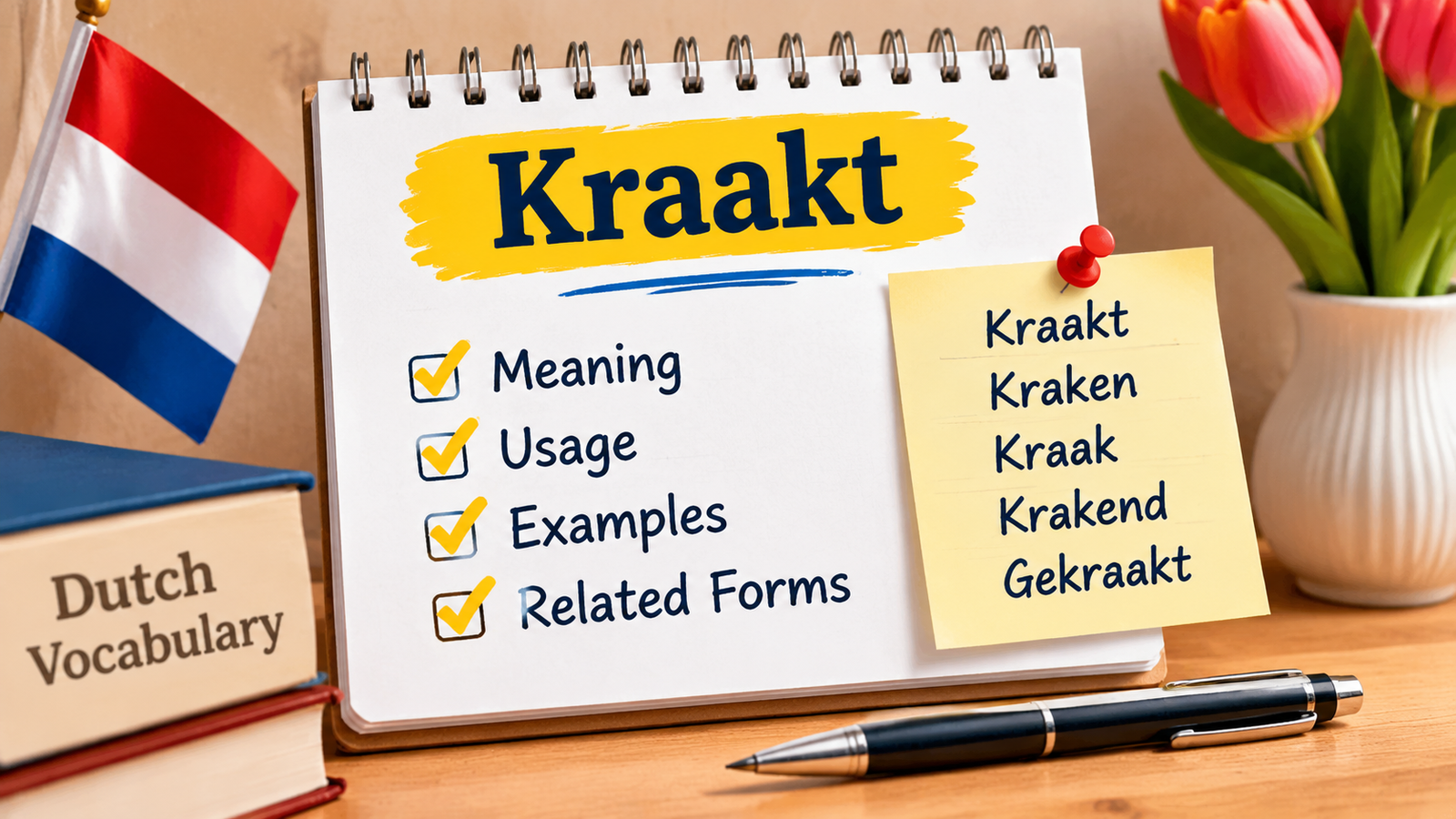


The word “kraakt” may look unusual to people who have never encountered the Dutch language, but it has several interesting meanings depending on how it is used. It is a Dutch word connected to the verb “kraken,” which can describe cracking, creaking, breaking something open, occupying an empty building, or even gaining unauthorized access to a computer system. Its meaning becomes clearer when you understand the sentence and situation in which it appears.
One reason kraakt attracts attention is that it is not limited to a single subject. It can appear in everyday conversations about sounds, discussions about damaged objects, descriptions of buildings, and even conversations involving technology. For example, someone might use it to describe an old wooden floor making noise or a difficult situation in which something is being broken open. These different applications make the word more interesting than a simple dictionary translation might suggest.
Understanding kraakt requires looking at its linguistic background, grammatical structure, cultural associations, and practical uses. Whether you discovered it while translating Dutch text, reading about European culture, or researching an unfamiliar online term, learning its meaning can help you understand how Dutch speakers use it in different situations. In this guide, we will explore the word in detail and explain why context matters when interpreting it.
What Does Kraakt Mean?
Kraakt is a conjugated form of the Dutch verb “kraken.” In standard Dutch grammar, it is used with the second-person singular and third-person singular in the present tense. Depending on the sentence, it can mean “you crack,” “he cracks,” “she cracks,” or “it cracks.” It is therefore not a completely separate word with one fixed English translation.
The most familiar meaning of kraken is making a cracking, creaking, or crunching sound. Imagine walking across an old wooden floor and hearing an unusual noise beneath your feet. A Dutch speaker might describe that situation by saying, “De vloer kraakt,” which means “The floor creaks.” Similarly, the word can describe ice cracking, furniture making noise, or a person’s voice sounding rough.
Another meaning involves breaking or forcing something open. For instance, cracking a nut, opening a safe, or breaking through a difficult barrier can be described using forms of kraken. In certain contexts, it can also refer to occupying an empty building without the owner’s permission or breaking into a computer system. These meanings share the general idea of opening, breaking, or gaining access to something.
The Origin and Linguistic Background of Kraakt
To understand kraakt properly, it helps to look at its original verb, kraken. Dutch is a West Germanic language closely related to English and German. Many Dutch words have recognizable connections to English vocabulary, particularly when they describe physical actions, sounds, and everyday activities. Kraken has a particularly interesting relationship with the English word “crack.”
The verb is associated with the idea of producing a sharp sound or breaking something apart. Think about the sound made when someone cracks a dry branch or steps on a thin piece of ice. These situations help explain the connection between the word’s sound-related and physical meanings. Over time, the verb developed different applications in ordinary speech and specialized contexts.
Kraakt is produced through Dutch verb conjugation rather than by creating an entirely new vocabulary item. The infinitive is kraken, while kraakt is used in particular present-tense grammatical constructions. This distinction matters because English speakers sometimes assume that kraakt is a noun or a standalone technical term. In ordinary Dutch grammar, it is primarily a verb form.
How Kraakt Is Used in Everyday Dutch Conversations
One of the easiest ways to understand kraakt is through everyday examples. Dutch speakers can use it when describing sounds that come from objects, buildings, or natural materials. An old staircase that makes noise whenever someone walks on it is a simple example. Instead of explaining the entire sound, a speaker can use one short verb to communicate what is happening.
The word can also describe food and other objects that produce a crisp sound. For example, a hard biscuit may crack when someone bites into it, while certain materials may make a sharp noise when pressure is applied. In these situations, the word communicates a physical experience rather than anything related to technology or property.
Kraakt can also appear in figurative expressions. A person might describe an organization, system, or relationship as something that is creaking under pressure. In this sense, the word suggests that something is struggling to function properly. This figurative use makes it possible to communicate tension or weakness without describing a literal cracking sound. The surrounding sentence usually makes the intended meaning clear.
Kraakt and the Dutch Squatting Movement
One of the more historically significant meanings associated with kraken involves the occupation of empty buildings. In the Netherlands, the term became closely connected with the squatting movement, in which people occupied unused residential or commercial properties without the owner’s permission. The practice became particularly visible during periods of housing shortages and urban redevelopment.
During the 1960s and 1970s, squatting became an important part of social and political discussions in Dutch cities. Some people occupied empty properties because they needed somewhere to live, while others viewed the practice as a way to challenge property speculation and the unnecessary abandonment of buildings. These activities also became associated with alternative communities, independent cultural spaces, and political activism.
The historical meaning of kraken is useful when researching Dutch culture because it shows how a word can develop beyond its original physical meaning. Rather than simply describing something being cracked open, it became associated with gaining access to unused property and making it available for occupation. However, the legal position of squatting has changed over time, and occupying a property without permission should not be confused with having a legal right to use it. In the Netherlands, squatting has been criminalized under legislation that took effect in 2010.
What Does Kraakt Mean in Technology and Cybersecurity?
Kraakt can also appear in discussions about computers, passwords, and cybersecurity. In this context, it is connected to the broader verb kraken, which can describe breaking into a protected digital system or defeating a security mechanism. The English equivalents may include cracking a password, breaking encryption, or compromising an account, depending on the situation.
For example, a sentence describing someone gaining unauthorized access to a password-protected account might use a form of kraken. The word communicates that a security barrier has been overcome. However, the precise technical meaning depends on what has been accessed and how the action was performed.
It is important to distinguish legitimate security testing from unauthorized access. Cybersecurity professionals sometimes perform controlled penetration tests to identify weaknesses in computer systems, while criminals may use similar techniques to steal information or access private accounts. Although the same general vocabulary can appear in both situations, the purpose and legal consequences are very different. Understanding the context prevents readers from assuming that every reference to kraakt involves criminal hacking.
Different Meanings of Kraakt Across Various Situations
The interesting thing about kraakt is that its meaning can change considerably depending on the subject being discussed. In a conversation about a house, it might describe a noisy floor, an old door, or a structure that makes sounds when pressure is applied. In a discussion about property, it may relate to the broader concept of squatting. In a technology article, it might refer to breaking a digital security barrier.
Another possible context involves criticism. The related Dutch verb “afkraken” means to criticize something harshly or speak very negatively about it. Although afkraken and kraakt are not interchangeable in every sentence, they share the same linguistic root. This is a useful distinction for people learning Dutch because adding a prefix can change the meaning of a verb considerably.
The word also appears in discussions about industrial processes. In petroleum refining, the related technical term “kraken” refers to cracking, a chemical process that breaks larger hydrocarbon molecules into smaller ones. This is entirely different from a wooden floor making a noise, even though the underlying vocabulary is related. Recognizing the subject of a conversation is therefore essential when translating kraakt accurately.
Kraakt vs. Kraken: Understanding the Difference
People searching for kraakt may also encounter the word kraken. Although the two forms are closely related, they serve different grammatical purposes. Kraken is the infinitive, or basic dictionary form, of the Dutch verb. It is comparable to the English word “to crack,” which is used when describing an action without specifying who performs it.
Kraakt is a present-tense form used with certain singular subjects. For example, “De deur kraakt” means “The door creaks.” Meanwhile, “Ik kraak” means “I crack” or “I creak,” depending on the intended meaning. These examples demonstrate how Dutch verb endings change according to grammatical person and sentence structure.
Understanding this difference is especially helpful for translators and language learners. Searching for kraakt may lead to dictionary entries that explain the larger verb rather than offering a separate definition. Instead of memorizing multiple unrelated translations, it is more useful to learn the main meanings of kraken and understand how its different conjugated forms work.
Common Examples of Kraakt in Dutch Sentences
Learning a word becomes much easier when you see how native speakers use it in real sentences. Kraakt is particularly straightforward in descriptions of sounds because the subject often makes its meaning obvious. For instance, a wooden floor, an old chair, or a frozen surface can all produce noises that are naturally described using this verb.
Here are some useful examples De houten vloer kraakt. The wooden floor creaks. Het ijs kraakt onder mijn voeten. The ice cracks beneath my feet.De oude deur kraakt. The old door creaks.De stoel kraakt wanneer ik ga zitten. The chair creaks when I sit down.De computer kraakt een wachtwoord. The computer cracks a password.
The final example is more context-dependent and would need a suitable technical context to sound natural. It demonstrates why direct translations should not always be treated as perfect equivalents. Dutch expressions often require adjustments in English to communicate the intended action naturally.
When learning the word, try identifying the subject and action in each sentence. Ask yourself whether something is producing a sound, breaking apart, or being accessed. This simple approach can help you determine the correct translation without relying entirely on a dictionary.
Why Is Kraakt an Interesting Word to Learn?
Kraakt is interesting because it demonstrates how a relatively simple verb can develop multiple meanings across different areas of life. It connects everyday sounds with physical actions, historical movements, and modern technology. For language learners, this makes it a useful example of how vocabulary evolves through cultural and practical use.
It also highlights the importance of grammatical knowledge. Someone who understands the relationship between kraakt and kraken can recognize different verb forms more easily. Rather than treating every variation as a new word, learners can identify the underlying verb and understand how it changes according to the sentence.
For translators, writers, and people researching Dutch terminology, understanding kraakt can prevent common translation mistakes. A word that describes a creaking floor in one sentence might refer to a completely different action in another. Paying attention to the subject, surrounding vocabulary, and overall meaning is the best way to interpret it correctly.
Conclusion
Kraakt is a Dutch present-tense form of the verb kraken, and its meaning depends heavily on the context in which it appears. It can describe a cracking or creaking sound, breaking something open, occupying an empty building, or overcoming a digital security barrier. Its different applications make it an interesting example of how language develops across everyday life, culture, and technology.
The word also has an interesting historical background, particularly because kraken became associated with the Dutch squatting movement. Its use in cybersecurity and industrial terminology further demonstrates how the same linguistic root can appear in very different fields. Understanding these connections makes it easier to recognize the word in unfamiliar sentences.
Ultimately, the best way to understand kraakt is to learn its relationship with kraken rather than memorize one English translation. Once you recognize its grammatical form and pay attention to the surrounding sentence, interpreting the word becomes much easier.
(FAQs)
What does kraakt mean in English?
Kraakt is a Dutch verb form that can mean “cracks,” “creaks,” or “makes a cracking sound,” depending on the sentence.
Is kraakt a Dutch word?
Yes, kraakt is a Dutch present-tense conjugation of the verb kraken.
What is the difference between kraakt and kraken?
Kraken is the infinitive form meaning “to crack,” while kraakt is a present-tense form used with certain singular subjects.
Can kraakt be used in technology?
Yes, the related verb kraken can describe cracking passwords or breaking through digital security protections.
Is kraakt related to the Dutch squatting movement?
Yes, kraken became historically associated with occupying unused buildings in the Netherlands, particularly during the 1960s and 1970s.